
5A) Cruising at 38,000ft: It’s warm up here...
- Yusuf Khan-Cheema

- May 1, 2020
- 4 min read
We made it. We’re at 38,000ft, the views are amazing and everyone’s smiling. But not everyone’s happy with me and my family. So today we’re going to examine the hot topic: my contribution to global warming. Just a word of warning, things may get a little complex at points but hopefully you'll come out the other end knowing more about my emissions and climate change than you ever thought you needed to know.

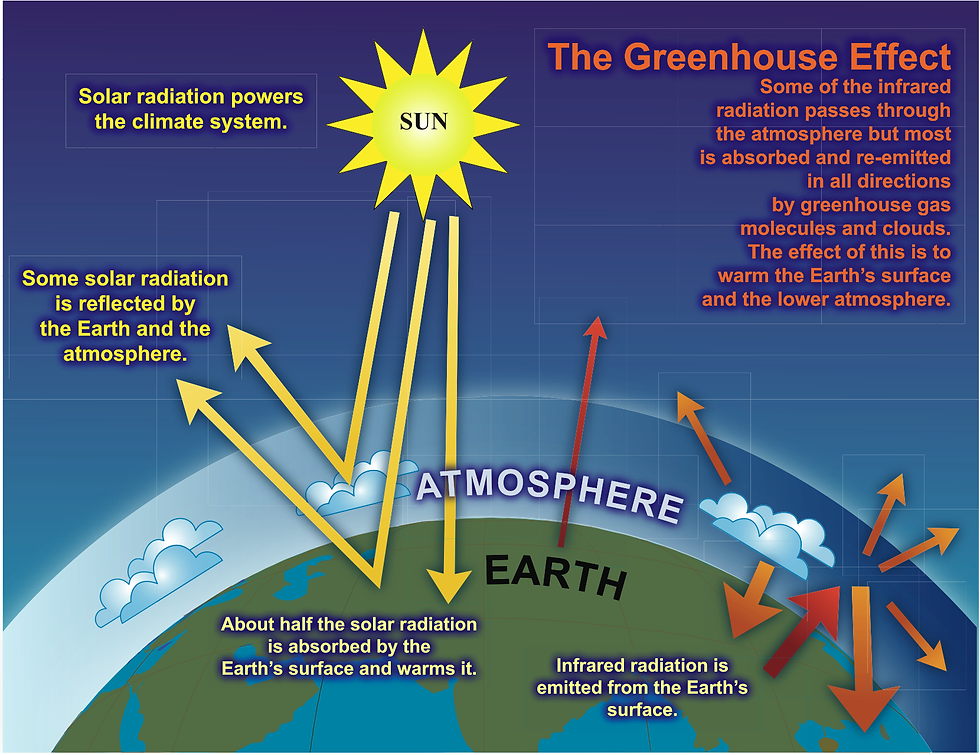
Whenever people think of me and the environment, they frequently draw attention to my carbon dioxide (CO2) emissions. CO2 is a greenhouse gas naturally present in the air, which absorbs and retains heat that would otherwise escape the earth’s atmosphere: this process is known as the greenhouse effect. So how am I warming the earth? When I burn fossil fuels to power my engines, I produce additional CO2 which enhances this natural greenhouse effect and leads to increased global temperatures.
In 2018, civil aviation (i.e. non-military) emitted 915 million tonnes of CO2, up by 25 million tonnes since 2018. This amounts to 2% of global carbon emissions. Not much, right? Given that this is just 12% of the transport sector’s emissions, you’re not wrong for thinking aviation isn’t so bad.
Nevertheless, it’s important to consider that only 20% of the world’s population have ever flown, so per capita emissions in Europe and the US are much higher compared to other modes of transport. Using the International Civil Aviation Organisation's (ICAO) emissions calculator tool, 1 passenger on a return flight between London to LA (in my economy section) emits just under 1 tonne of CO2, roughly the same as the average person in Pakistan emits per year! This is tripled when you take the same flight in business-class (but more on that later). So, when considering your own emissions, flying is likely a big chunk of your carbon footprint.

But I emit other greenhouse gases like nitrogen oxides (NOx) and water vapour that also contribute to global warming, so why the focus on CO2? Well, CO2 is what you’d call ‘well-mixed’; essentially, it lingers in the atmosphere for up to 100 years, much longer than other greenhouse gases, allowing it to circulate around the earth and have a much greater warming effect.
However, not all the CO2 I emit remains in the atmosphere, largely thanks to the oceans. I spend most of my days traversing them on transatlantic flights, but only now am I really starting to appreciate them. Around 40% of the CO2 humans have emitted since the industrial revolution is absorbed by the oceans. This is primarily due to oceanic plankton photosynthesising as well as CO2 physically dissolving into the water and circulating into the deep-ocean. Although aviation is just one of many sources, anthropogenic CO2 can have devastating consequences for coral reefs and other carbonate organisms by increasing the acidity of seawater on which they depend. But like I said, there are far bigger sources of CO2 than my family, namely energy production and industrial processes.
Although my CO2 emissions have the most significant impact on global warming, it is not the whole story. Take my NOx emissions, for example. As a greenhouse gas, it also has a small warming effect. But research by the IPCC suggests that when I emit NOx at high altitudes, it promotes the formation of ozone which has an additional warming effect. NOx also decreases the concentration of another greenhouse gas, methane, therefore cooling the atmosphere. And just when you thought I couldn’t make it any more complicated, further cooling occurs when I release sulphate aerosols and water vapour (which unlike NOx actually deplete ozone). Here’s a useful graphic that hopefully clears things up: the main take-away is that I emit other gases and pollutants aside from CO2 that contribute to global warming.

One effect that isn’t mentioned here is that of black carbon (particulate matter emitted from my engines), which warms the atmosphere at a third of the rate of CO2 by absorbing solar radiation. Whilst I emit 20% of global black carbon emissions, research around its impact remain inconclusive.

Many of my other emissions, however, don’t remain in the atmosphere for long and so the impacts tend to be more localised around flight paths. And none are as localised as my contrails, those white trails I leave in my wake. Resembling cirrus clouds that naturally form at high altitudes, they form when water vapour condenses around black carbon and soot particles emitted from my engines. Unlike typical low-altitude clouds which have a net cooling effect, my contrails are so thin and high-up that they don’t reflect much sunlight away from the earth. Instead they can have a warming effect double that of CO2 emissions, particularly in sensitive areas like the Arctic (which many planes fly over). What is particularly worrying is that the Arctic is already the fastest warming region due to the ice-albedo effect.
However, the impacts of my contrails are still unclear, with suggestions that warming is more evident at night whilst cooling occurs during the day.
So how do my emissions compare to a car’s? Let’s return to my example of flying to LA and imagine you could drive there. With no other passengers, driving actually emits more CO2 per kilometre than flying. However, when you account for my secondary non-CO2 effects, flying has a greater warming impact. Evidently, the current focus on CO2 emissions overlooks these important secondary climate effects and is something that my creators need to address with passenger numbers predicted to double over the next two decades (note these predictions were made before the coronavirus pandemic).


Comments