
8A) A technological fix?
- Yusuf Khan-Cheema

- Jun 12, 2020
- 3 min read
Talking about myself was easy, but now let’s address the big question: what are my family doing to reduce my environmental impact? Today, let’s focus on two of IATA’s four-pillar strategy: technology and improving efficiency.
Let's begin with Ryanair, who just last year claimed to be Europe’s greenest airline. As the only non-coal company in the top ten carbon emitters in Europe, how did they reach this conclusion? Aside from operating a point-to-point network (flying direct as opposed to having stopovers at a 'hub' airport), Ryanair has one of the lowest per passenger CO2 emissions by way of their high load factors; on average, they fill 94% of the seats on flights they operate. Ryanair also has one of the newest and most-fuel efficient fleet of aircraft; across the industry, airlines have invested over $1 trillion since 2009 to replace older aircraft like me.
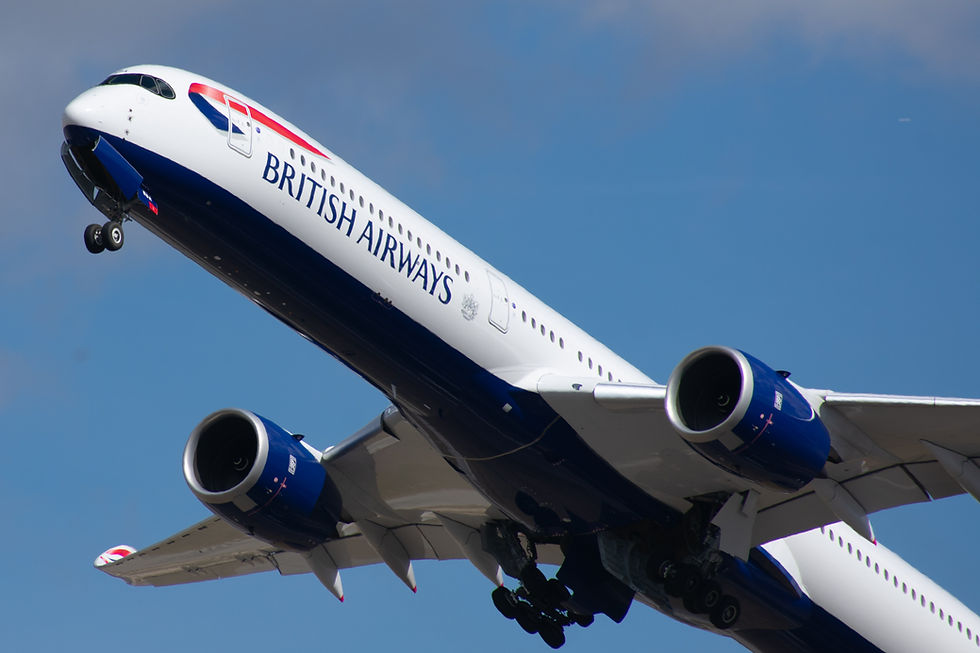
Improved fuel-efficiency is a win-win for airlines, reducing fuel costs (currently a quarter of their expenditure) and their emissions. Minimising weight is crucial to this: lightweight loading devices, palettes and e-freight (going paperless) are helping to reduce air cargo emissions; whilst lightweight composite materials, improved aerodynamics and using two engines (as opposed to my four) have decreased the B787 and A350’s CO2 emissions by 20-25%. Consequently, emissions per passenger have declined 50% since 1990. NASA is currently designing a blended-wing-body, whose improved aerodynamics could further reduce fuel burn by 27%.

Maximising airspace efficiency – through continuous descent procedures, reduced aircraft holding and flexible navigation systems taking advantage of favourable winds – is also important for reducing emissions. Congestion at Heathrow meant each aircraft waiting to land emitted ten tonnes of CO2, the same as one Singaporean emits each year!
Amidst variable oil prices and pressure to decarbonise, sustainable aviation fuels (SAFs) feature heavily in my family’s emission-reduction plans. Including biofuels (made from algae or jatropha) and synthetic fuels (composed of domestic waste), SAFs have provided a renewable alternative to kerosene since 2011. Throughout their lifecycle, SAFs reduce CO2 emissions by 80%, atmospheric particulates (required for contrail formation) by 50-70% and local particulate matter by 90%, benefitting the climate as well as human health.
However, emission reductions aren’t as significant when SAFs are blended with kerosene, grown in high-carbon soils and when considering those non-CO2 impacts I mentioned beforehand. Currently, SAFs contribute 0.1% of aviation fuels and increasing their share to 2% of aviation fuels by 2025 will require annual investments of $15-60 billion in large bio-refineries. Cost premiums up to $30/passenger may also initially deter airlines from purchasing more SAFs. Amidst population growth, biofuel demand will require land that is also needed for food production whilst increased application of fertilisers and insecticides for biofuel feedstock may increase water pollution. Although proposals to produce jet fuel from CO2 in the air are promising, the pilot plant would produce enough fuel per day to power me for five minutes. Evidently, SAFs are a short-term fix to a long-term problem.
So why don’t we turn to electric planes? Whilst cars can handle the extra weight of batteries, aircraft can’t; more weight requires more power to get an aircraft airborne, but current battery technology simply cannot replicate the energy density of kerosene necessary for my operation. Avoiding excess weight helps minimise the amount of fuel required and thus the cost of operating a flight; just think about how strict airlines are on baggage weight allowances. Nevertheless, dreams of electric flight continue with Airbus, Siemens and Rolls Royce announcing the E-fan X; carrying 100 passengers, this Hybrid-electric plane burns 10% less fuel with its 2MW electric motor powered by three turbine engines.

Electrifying small aircraft flying short distances is certainly possible, given the first all-electric commercial flight operated at the end of 2019. Progress continues to be strong in this sector of the aviation industry; last month saw the first flight of a converted 9-seater Cessna caravan, the largest electric aircraft to ever fly. However, IATA believes fully-electric airlines (the ones you would take to go on holiday) won’t appear before 2040 whilst electric long-haul flights may never come to fruition. Given flights over 1500km are responsible for 80% of aviation’s emissions, electrification clearly isn’t the solution we need to avoid my environmental impacts. For now, SAFs remain the main way to mitigate my emissions.


Comments